Cybersecurity vs Information Security: What Is the Difference?
Cybersecurity vs Information Security: What Is the Difference?
Cybersecurity and information security are often used interchangeably, but they are not exactly the same thing.
Both focus on protecting valuable information and reducing security risks, but their scope and areas of focus can differ.
If you've ever wondered "What is the difference between cybersecurity and information security?", you're not alone.
The terms are closely related because both involve protecting information from unauthorised access, misuse, alteration, loss or destruction. However, cybersecurity generally focuses more specifically on protecting digital systems, networks, devices, applications and digital data, while information security has a broader focus on protecting information regardless of whether it is stored digitally, physically or in another form.
Understanding the difference can be useful if you're a student, professional, business owner, IT specialist or someone considering a career in cybersecurity.
In this guide, we'll explain cybersecurity vs information security, what each field covers, how they overlap and how to decide which area may be right for you.
What Is Cybersecurity?
Cybersecurity is the practice of protecting digital systems, networks, devices, applications and data from cyber threats.
These threats can include:
- Phishing
- Malware
- Ransomware
- Data breaches
- Credential attacks
- Social engineering
- Vulnerability exploitation
- Unauthorised access
- Denial-of-service attacks
Cybersecurity is primarily concerned with the security of the digital environment.
For example, cybersecurity can help protect:
- Company networks
- Cloud systems
- Websites
- Mobile devices
- Computers
- Business applications
- Digital accounts
- Online databases
Cybersecurity professionals may work on preventing attacks, detecting suspicious activity, investigating incidents and helping organisations recover from security incidents.
What Is Information Security?
Information security, often called InfoSec, is the practice of protecting information from unauthorised access, use, disclosure, alteration, disruption or destruction.
The important distinction is that information security isn't limited to digital information.
Information can exist in many forms.
For example:
- Digital files
- Emails
- Printed documents
- Contracts
- Employee records
- Customer information
- Financial documents
- Physical storage devices
- Verbal or confidential information
Information security therefore takes a broader view of how information is protected throughout its lifecycle.
It considers questions such as:
Who should have access to this information?
Where is it stored?
How should it be handled?
How long should it be retained?
What happens when it is no longer needed?
Cybersecurity vs Information Security: The Main Difference
The simplest way to understand the difference is:
Cybersecurity focuses primarily on protecting digital environments from cyber threats, while information security focuses on protecting information in all forms.
Think of it this way:
Information Security
⬇
Protects information in digital and physical forms
Cybersecurity
⬇
Focuses primarily on protecting digital systems, networks, devices and data
Cybersecurity can therefore be considered an important part of the wider information security landscape.
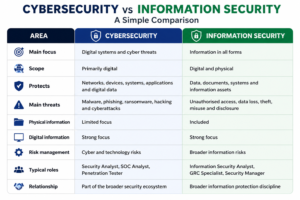
Cybersecurity vs Information Security: A Simple Comparison
The boundaries can overlap, and organizations may define roles differently.
What Do Cybersecurity and Information Security Have in Common?
Although they are different disciplines, cybersecurity and information security share many goals.
Both aim to protect:
Confidentiality
Information should only be available to authorized people.
Integrity
Information should remain accurate and protected from unauthorized changes.
Availability
Authorized users should be able to access information when needed.
These three principles are commonly known as the CIA triad and form a foundation for many information security and cybersecurity practices.
Cybersecurity vs Information Security: An Example
Imagine a company has confidential customer information.
The information is stored in a cloud database but some records are also printed and kept in a physical office.
Cybersecurity might focus on:
- Securing the cloud environment
- Protecting user accounts
- Monitoring network activity
- Detecting malware
- Preventing unauthorised digital access
- Securing applications
- Managing vulnerabilities
Information security might consider:
- Who is authorised to access the customer information
- How the digital records are protected
- How printed documents are stored
- How information is shared
- How long records should be retained
- How information should be securely destroyed
- What policies employees must follow
This example shows why information security has a broader scope.
Is Cybersecurity Part of Information Security?
In many organisations and professional contexts, cybersecurity is considered a component or specialised area within the broader information security discipline.
However, terminology varies between organisations, industries and job roles.
Some companies may use "cybersecurity" and "information security" almost interchangeably.
Others may have separate teams with different responsibilities.
For example:
Information Security
→ Governance → Risk Management → Policies → Data Protection → Access Management → Security Awareness
Cybersecurity
→ Network Security → Threat Detection → Incident Response → Endpoint Security → Application Security → Cloud Security
The exact structure depends on the organisation.
What Does an Information Security Professional Do?
An information security professional may be responsible for protecting information across its entire lifecycle.
Responsibilities can include:
- Developing security policies
- Conducting risk assessments
- Managing access controls
- Supporting compliance
- Protecting sensitive information
- Developing security awareness programmes
- Managing information security risks
- Reviewing third-party risks
- Supporting incident management
Information security roles can therefore involve both technical and non-technical responsibilities.
What Does a Cybersecurity Professional Do?
Cybersecurity professionals often focus on defending digital environments against cyber threats.
Depending on the role, responsibilities may include:
- Monitoring security alerts
- Investigating suspicious activity
- Conducting vulnerability assessments
- Responding to incidents
- Securing networks
- Protecting endpoints
- Testing applications
- Analysing threats
- Investigating security events
Cybersecurity is a broad field, so the responsibilities can vary significantly between roles.
Cybersecurity vs Information Security: Which One Is More Technical?
This depends on the specific role.
Generally, cybersecurity roles can involve a strong technical component, particularly areas such as:
- Network security
- Penetration testing
- Security operations
- Digital forensics
- Malware analysis
- Cloud security
Information security roles can also be highly technical, but some roles place greater emphasis on:
- Governance
- Risk
- Compliance
- Policies
- Data protection
- Security management
This means neither field is exclusively technical or non-technical.
There are opportunities for people with different backgrounds and interests.
Cybersecurity vs Information Security: Which Career Is Right for You?
Your choice may depend on what you enjoy and the type of work you want to pursue.
Cybersecurity may suit you if you enjoy:
- Technology
- Problem-solving
- Threat detection
- Investigating incidents
- Networks
- Systems
- Security tools
- Technical challenges
You might explore roles such as:
- Cybersecurity Analyst
- SOC Analyst
- Security Engineer
- Penetration Tester
- Incident Response Analyst
- Cloud Security Specialist
Information security may suit you if you enjoy:
- Risk management
- Business processes
- Policies
- Governance
- Compliance
- Data protection
- Security management
Potential roles include:
- Information Security Analyst
- Information Security Manager
- GRC Analyst
- Security Risk Analyst
- Compliance Specialist
- Data Protection Professional
There is also significant overlap between the two career paths.
What Skills Do You Need for Cybersecurity?
Cybersecurity professionals can benefit from a combination of technical and professional skills.
Technical skills
Depending on your chosen specialisation:
- Networking
- Operating systems
- Cloud computing
- Security tools
- Vulnerability management
- Identity and access management
- Threat detection
- Incident response
Professional skills
- Critical thinking
- Problem-solving
- Communication
- Attention to detail
- Analytical thinking
- Continuous learning
Cybersecurity is a rapidly changing field, so the ability to keep learning is particularly valuable.
What Skills Do You Need for Information Security?
Information security professionals may need skills in:
- Risk assessment
- Security policies
- Governance
- Compliance
- Data protection
- Access management
- Security awareness
- Business continuity
- Risk management
- Communication
Technical knowledge can still be highly valuable, especially when working with IT and cybersecurity teams.
Why Understanding the Difference Matters for Businesses
For businesses, understanding the relationship between cybersecurity and information security can help create a more complete approach to protecting information.
An organisation may have excellent technical security but still face risks from:
- Poor access policies
- Weak employee awareness
- Uncontrolled physical documents
- Excessive user permissions
- Poor data retention practices
- Third-party risks
- Inadequate security procedures
Cybersecurity and information security should therefore work together.
Technology protects digital environments.
Information security protects information across its lifecycle.
Together, they support a stronger security strategy.
Cybersecurity vs Information Security in the Workplace
Consider a company employee who receives a confidential customer document.
Information security asks:
How should this information be handled?
Cybersecurity asks:
How do we protect the digital systems through which this information is accessed, stored or transmitted?
Both questions matter.
This is why modern organisations increasingly need professionals who understand the relationship between technology, information and business risk.
Common Misconceptions About Cybersecurity and Information Security
"They are exactly the same thing."
Not necessarily.
They overlap significantly, but information security generally has a broader scope.
"Information security only deals with paperwork."
No.
Information security includes digital information as well as physical and other forms of information.
"Cybersecurity is only about hacking."
No.
Cybersecurity includes prevention, detection, risk management, incident response, security operations and many other areas.
"You need to be a programmer to work in cybersecurity."
Programming can be valuable for some cybersecurity roles, but it isn't required for every cybersecurity career.
"Information security is not technical."
Some information security roles are highly technical, while others focus more on governance, risk and compliance.
Cybersecurity and Information Security Are Both Important
Rather than asking which field is more important, organisations should recognise that both disciplines contribute to effective security.
Cybersecurity helps defend digital environments.
Information security helps protect information more broadly.
The two areas overlap and often work together to protect an organisation's most valuable digital and information assets.
As businesses continue to adopt cloud computing, artificial intelligence, remote work and digital services, the need for professionals who understand security will continue to grow.
Final Thoughts
So, what is the difference between cybersecurity and information security?
The simplest explanation is:
Cybersecurity focuses primarily on protecting digital systems, networks, devices, applications and data from cyber threats.
Information security takes a broader approach to protecting information, whether that information is digital, physical or otherwise recorded.
They are closely connected, and neither should be viewed in isolation.
If you're considering a career in the field, understanding this distinction can help you explore the right skills, training and career path for your interests.
And if you're a business leader or professional, understanding both concepts can help you make better decisions about protecting your organisation's information and digital environment.
Cybersecurity protects the digital world. Information security protects the information that matters within it.
Want to Learn More About Cybersecurity?
Understanding the difference between cybersecurity and information security is a good starting point. The next step is developing practical knowledge and skills.
Docenti Global Business School is hosting a Cybersecurity: Protect Today, Prepare for Tomorrow — One-Day Professional Seminar on 22 August 2026.
💻 Format: Online / Live Session 🕘 Time: 9:00 AM – 4:00 PM
In collaboration and partnership with Uptitek & LOUKAMA TECH SOLUTIONS.
The seminar will explore cybersecurity awareness, current cyber threats, digital protection and professional development opportunities.
Register for the Cybersecurity Seminar
[Secure Your Spot → Registration Link]
You can also download our free cybersecurity resource:
Cybersecurity in 2026: A Practical Guide to Digital Threats, Protection & Career Opportunities
[Download the Free Guide]
Interested in developing deeper professional cybersecurity skills?
Explore Docenti's Advanced Diploma in Cybersecurity
Frequently Asked Questions
Is cybersecurity the same as information security?
No. They overlap, but information security generally has a broader scope, covering the protection of information in both digital and physical forms. Cybersecurity focuses more specifically on protecting digital systems and environments from cyber threats.
Which is better, cybersecurity or information security?
Neither is universally better. The right choice depends on your interests and career goals. Cybersecurity may suit people interested in technical security and cyber threats, while information security can be a good fit for people interested in risk, governance, compliance and information protection.
Is cybersecurity part of information security?
Cybersecurity is commonly treated as a specialised part of the broader information security landscape, although organisations may define and structure the two disciplines differently.
Can I work in cybersecurity without an IT degree?
Yes. A formal IT degree can be helpful, but cybersecurity careers can also be entered through relevant training, certifications, practical experience and demonstrated skills.
What is the main goal of information security?
The main goal is to protect information's confidentiality, integrity and availability while managing the risks associated with how information is created, stored, accessed, shared and disposed of.
What is the main goal of cybersecurity?
Cybersecurity aims to protect digital systems, networks, devices, applications and data from cyber threats while helping organisations prevent, detect, respond to and recover from security incidents.


Comments
Post a Comment